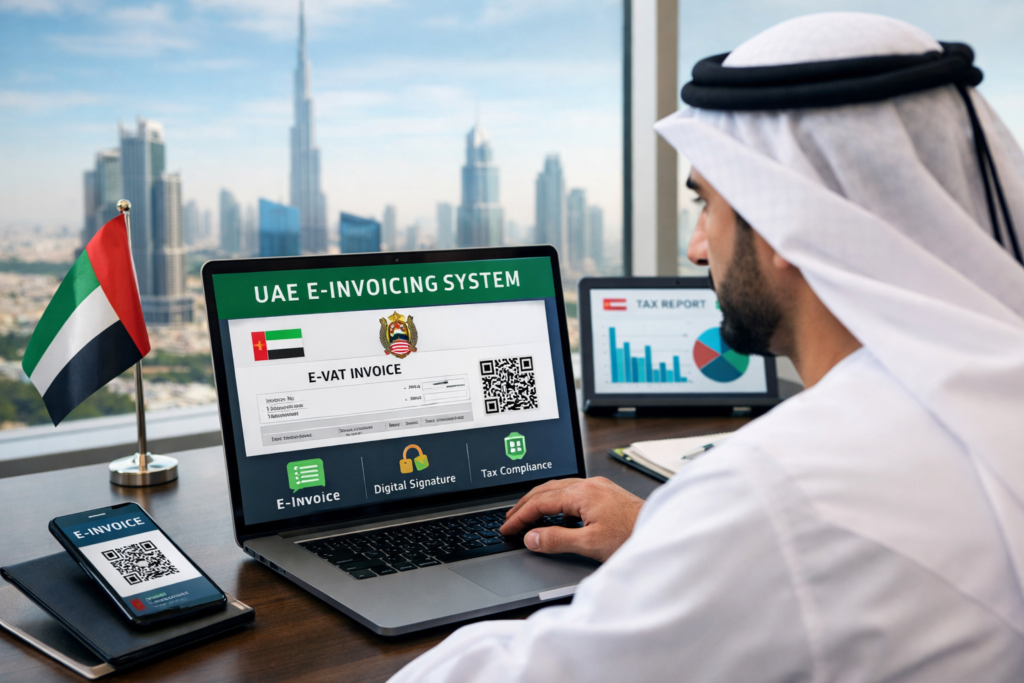
In 2026, the UAE introduced a new national e-invoicing system that changes how most businesses issue and report invoices. This is one of the most significant tax and digital compliance reforms in the country’s recent history.
Here are the key changes implemented in 2026:
1. Pilot phase launch (July 1, 2026)
The UAE began a pilot programme for e-invoicing on 1 July 2026. This allowed a group of selected businesses to start using the system and test compliance ahead of mandatory deadlines. Other companies could also adopt the system voluntarily from this date.
2. Legal framework and digital system foundation completed
New Ministerial Decisions and amendments to the VAT and tax laws were finalised leading up to 2026, creating the official legislative basis for e-invoicing and defining technical and operational standards. This included recognition of electronic invoices and credit notes and technical rules for how they must be generated and stored.
3. Structured electronic formats required
Under the new rules starting in 2026, invoices must be issued in machine-readable structured formats (such as XML/JSON based on the PINT AE or Peppol standard). Traditional invoices as paper, scanned images, PDFs, or unsecured documents are no longer accepted for compliance reporting.
4. Accredited Service Providers (ASPs) introduced
Businesses must use an Accredited Service Provider (ASP) to generate and transmit e-invoices. The ASP validates invoice data, applies required standards, and sends it to the Federal Tax Authority (FTA) in near-real time.
5. Real-time (or near real-time) reporting to the FTA begins
With e-invoicing, invoice data is reported quickly to the tax authority rather than being collected later through periodic VAT returns. This improves transparency and oversight of taxable transactions.
6. Phased compliance timeline put in place
Although 2026 itself marks the start of the e-invoicing era, full mandatory use comes in stages:
- Voluntary use and pilot starts: 1 July 2026
- Large businesses must appoint ASPs by 31 July 2026 and fully implement by 1 January 2027
- Smaller businesses and government entities have later deadlines in 2027.
7. Focus on B2B and B2G transactions
The initial 2026 requirements focus mainly on Business-to-Business (B2B) and Business-to-Government (B2G) invoices. Business-to-Consumer (B2C) invoices are generally not in the mandatory scope yet and may be included later.
The major new thing implemented in 2026 was the rollout of the UAE’s mandatory e-invoicing framework, starting with a pilot and preparation period and laying the foundation for full compliance in early 2027. The goal is to modernise invoicing, strengthen VAT compliance, and shift the economy toward digital, real-time tax reporting.
___